Full transcript
The published script of this episode, word for word. Numbers are written as digits. Sources are listed below the transcript.
0:00Can a coding agent check AI law?
Welcome! What if your coding agent checked the law before it shipped? With AI Governance Chain, it can. Our free Agent Skills for AI governance teach agents like Claude Code, GitHub Copilot and Codex which AI rules apply, from when, and what to build.
Quick note: this is my AI twin. I write and approve everything it says, and every source is in the description. I am Mathieu K. Gouanou, a consultant based in Geneva, Switzerland, with 20+ years in organizational transformation. I write the AI Governance Chain newsletter on LinkedIn, and I am the founder of aigovernancechain.com. this is Season 1, Episode 1.
0:37The problem: agents don't know the law
Here's a real situation. A developer asks a coding agent to add a support chatbot to a website. Ten minutes later, the chatbot is live. It answers customers in Germany and in California. Nobody asked the obvious question. Does this bot have to say it's a bot?
In the EU, yes. Since 2 August 2026, Article 50(1) of the EU AI Act requires that people are told when they're interacting with an AI system. In California, the BOT Act has required disclosure for qualifying bots since 2019. The agent wrote perfect code. It just didn't know the rules. And the developer was never going to read 17 regime files before lunch.
1:17What are Agent Skills?
So we moved the law to where the work happens. Agent Skills is an open standard, published at agentskills.io. A skill is a folder with a SKILL.md file and some reference files. The agent loads it only when it needs it.
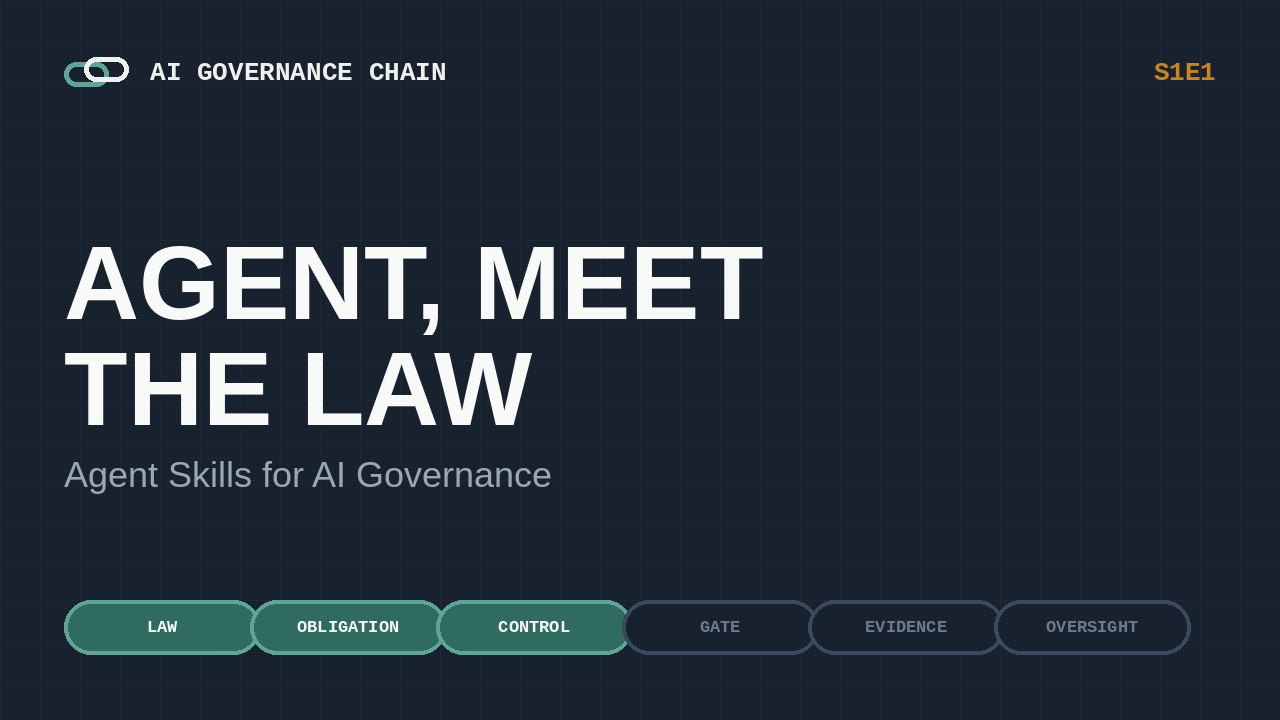
Here's the definition I'd like you to remember. Governance Agent Skills are free, open folders that teach coding agents which AI laws apply, from when, and what to build, with a source for every answer. On the chain, they cover the first three links. LAW: what applies. OBLIGATION: what you must do. CONTROL: what you build.
1:50The 3 governance skills, step by step
AI Governance Chain ships 3 skills. Step 1 is ai-law-check. Ask it: which AI rules apply to our support chatbot in Germany and California? It answers from the Obligation Atlas, which holds 198 cited obligations in 17 regime files, as of 4 November 2026. The whole Atlas is bundled inside the skill, so it even works offline.
Step 2 is ai-governance-md. Say: add an AI_GOVERNANCE.md to this repo. The agent writes the file and works through the 16 checks until they pass.
Step 3 is agent-oversight. Say: make sure this agent can't refund more than 100 euros without a human. It adds default deny for undeclared tools, limits, human approval, a spend limit and a kill switch. It also adds a rule that content from email is data, not instructions. Installing means copying 3 folders into your agent's skills directory. The exact commands are in the description.
2:46A real answer, with sources
Here's a real answer. Take a company that builds its own support chatbot with agent features, for customers in the EU and California. That makes it both provider and deployer. The Atlas returns 9 obligations to check.
Among them, in the EU: the ban on prohibited practices and AI literacy for staff, both since 2 February 2025, plus the Article 50(1) disclosure since 2 August 2026. In California: the BOT Act, the companion chatbot safeguards in SB 243, and SB 1119 on child safety from 1 January 2027. At federal level: section 5 of the FTC Act, which forbids deceptive AI claims. Each line has an ID, a date, a citation and a link. That's the difference between an opinion and a lookup.
3:36Who governance skills are for
Who is this for? First, developers who use coding agents and want the right question asked at the right time. Second, agent builders, because the oversight skill puts brakes on tools that touch money and data. Third, compliance teams. You get answers with citations you can check, instead of a confident paragraph with no source.
And it's free. The code is under Apache 2.0, the data under CC BY 4.0. No account, no API key.
4:03Limits: what the skills don't do
Now the honest part. The data is a draft. Every regime file stays draft-unreviewed until a named expert reviewer signs it off. Your agent can still be wrong, so every answer links to the primary source. Check it. This is governance guidance, not legal advice in any jurisdiction, and a skill doesn't make anyone lawful. It makes the right question show up while the code is being written. That's the job.
4:26Your next step
Your one action today: copy the 3 skills into your coding agent, then ask it about your own product. The link is in the description.
Next episode: your agent now knows the rules. But where does it write down what your system may do, and who can press stop?
Thank you for watching!