AI Governance Chain
  1. Watch
  2. Pilots
  3. The Stop Button Files, File 01

AI Chatbot Liability: Moffatt v. Air Canada in 90 Seconds

AI chatbot liability: in Moffatt v. Air Canada, 2024 BCCRT 149 (14 February 2024), a Canadian tribunal held Air Canada responsible for misleading bereavement-fare information from its website chatbot and ordered it to pay CAD 812.02. The tribunal said it makes no difference whether information comes from a static page or a chatbot.

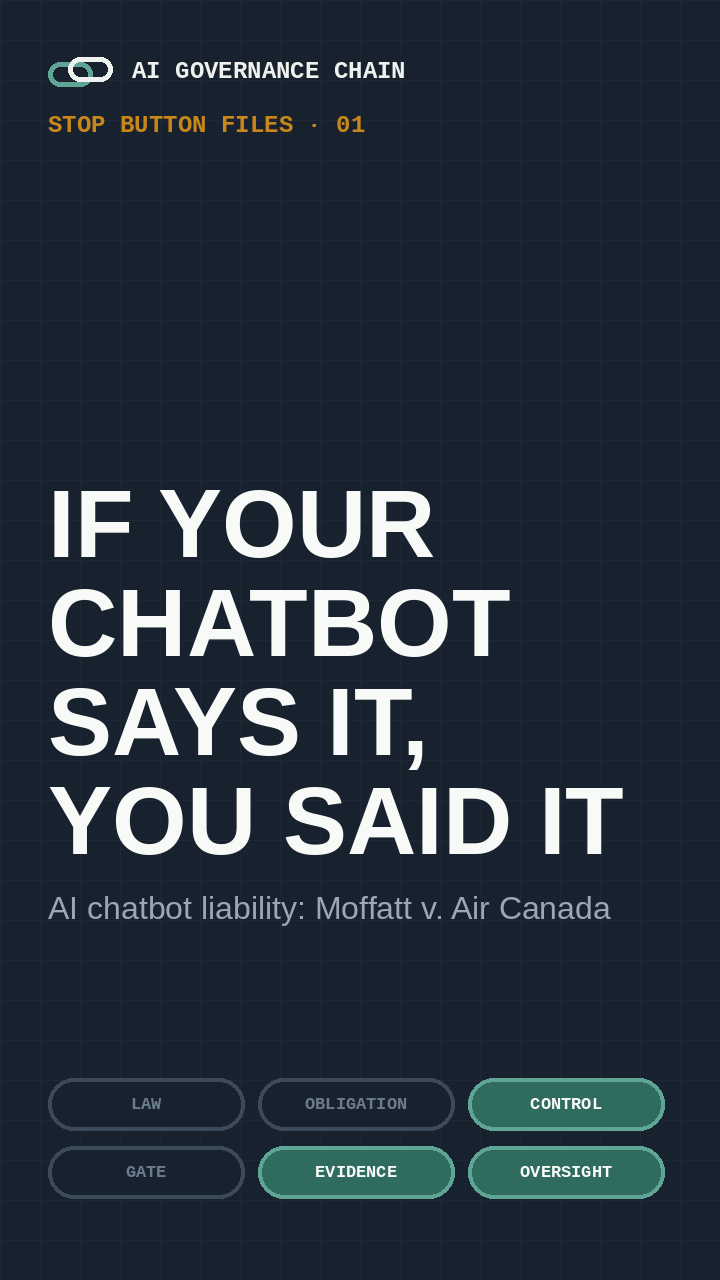
SBF01 poster: If Your Chatbot Says It, You Said It. The Chatbot Said It.
Out Thu 19 Nov 2026 · 08:00 Geneva timeRead the transcript

Out on Thursday 19 November 2026 at 08:00, Geneva time (CET).Until then, the full transcript is below.

SBF01 · The Stop Button Files · The Chatbot Said It · about 94 seconds, vertical. Presented by my AI twin. Script and sources by Mathieu K. Gouanou. Dramatisation with fictional stand-ins; scenes are AI-generated. Not legal advice. Facts checked 5 November 2026.

Links of the chain in this episode: Control, Evidence, Oversight

Full transcript

The published script of this episode, word for word. Numbers are written as digits. On-screen label for the generated scenes: Dramatisation. AI-generated. Sources are listed below the transcript.

0:00Can a company blame its own chatbot?

Can a company blame its own chatbot? One airline tried.

The Stop Button Files from AI Governance Chain replays real AI cases, and the control that stops them. File 01 starts in November 2022.

0:18What the chatbot said

A passenger's grandmother has just died. The passenger asks Air Canada's website chatbot about bereavement fares.

The chatbot says the reduced rate can be claimed within 90 days of the ticket being issued. So the passenger flies, then applies.

0:34The refusal and the ruling

The airline refuses. Its policy page said bereavement rates don't cover travel already completed.

In effect, said the tribunal, the airline treated its chatbot as a separate legal entity. A remarkable submission. Its finding: it makes no difference whether the information comes from a static page or a chatbot.

In February 2024, the airline was ordered to pay just over 812 Canadian dollars. Small money. Big principle.

1:02If your chatbot says it, you said it

On your website, if your chatbot says it, you said it.

1:06The control

The control I'd put in place: 1. Policy answers come only from the current policy text, with the source linked. 2. Promises, refunds and discounts go to a human or a hard rule. 3. Every answer is logged.

1:22Try it: Agent Jail

Watch rules stop a runaway agent in 30 seconds: run Agent Jail from AI Governance Chain, link below. Next file: the lawyers who trusted six cases that never existed.

Short answers

Is a company liable for what its chatbot says?

In Moffatt v. Air Canada (2024 BCCRT 149), a Canadian tribunal held the airline responsible for its chatbot's misleading answer and found negligent misrepresentation. Rules differ by country. Not legal advice.

What did the Air Canada chatbot say?

That a reduced bereavement rate could be claimed within 90 days of the ticket being issued. The airline's policy page said bereavement rates did not apply after travel.

How do you stop a chatbot from making promises?

Answer policy questions only from current policy text with the source linked, send promises, refunds and discounts to a human or a hard rule, and log every answer.

Questions this episode answers

Sources

  1. CBC News, Air Canada found liable for chatbot's bad advice
  2. McCarthy Tetrault, Moffatt v. Air Canada analysis
  3. Legal 500, summary of the decision
  4. AI Governance Chain on GitHub